Kirjeldus
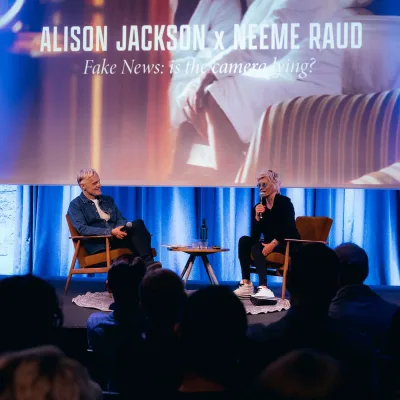
The episode was recorded as a live talk on May 12, 2026. For the best experience, watch the video version of the talk on YouTube: https://www.youtube.com/watch?v=YpEor78FJBw
How is a lie born when it still feels so conviningly true and why are we so willing to believe it?
With Fotografiska’s summer major exhibition “Photography in Power: Making Worlds Visible”, British artist Alison Jackson visited Estonia in May 2026.
Her staged realities have made audiences hesitate, smile, and sometimes feel uneasy, and have even disrupted public space so provocatively that her “truths” have at times been removed from the urban environment.
Jackson creates images of events that have never happened, celebrities appearing to do things they never actually did. Or did they? Fake news is not only created in front of us, but also within us, in the moment we choose to believe something.
Why are we drawn to stories that confirm our biases? Where does the line between real and fictional lie, and why is it becoming increasingly blurred in today’s world? Through sharp satire and provocation, Jackson’s work reveals our own desire to believe what seems too good (or too scandalous) to be false.
The conversation grows from photographic art into a broader exploration of the nerves of our time, unfolding unexpected perspectives and sharp observations.
The discussion with Alison Jackson is led by acclaimed journalist Neeme Raud.
Photography in Power: Making Worlds Visible , group exhibition, 6 May – 13 September
Photography in Power: Making Worlds Visible brings together 127 photographers whose work has shaped how we see, interpret, and perceive the world today – among them Helmut Newton, Robert Mapplethorpe, Richard Avedon, Alison Jackson, and David LaChapelle. The exhibition moves between inner and outer worlds, exploring social tensions, identity, and the paradoxes of beauty and its representation.
At the intersection of documentary and staged approaches, the personal meets the political, vulnerability meets resistance. Photography here is not merely a technique, but a way of making the world visible – revealing connections that might otherwise remain unseen.